
You bought the system for what it produces. Dust doesn’t announce that it’s taking a cut, and that’s the problem: the loss shows up on a utility bill months later, not on the roof where you’d see it.
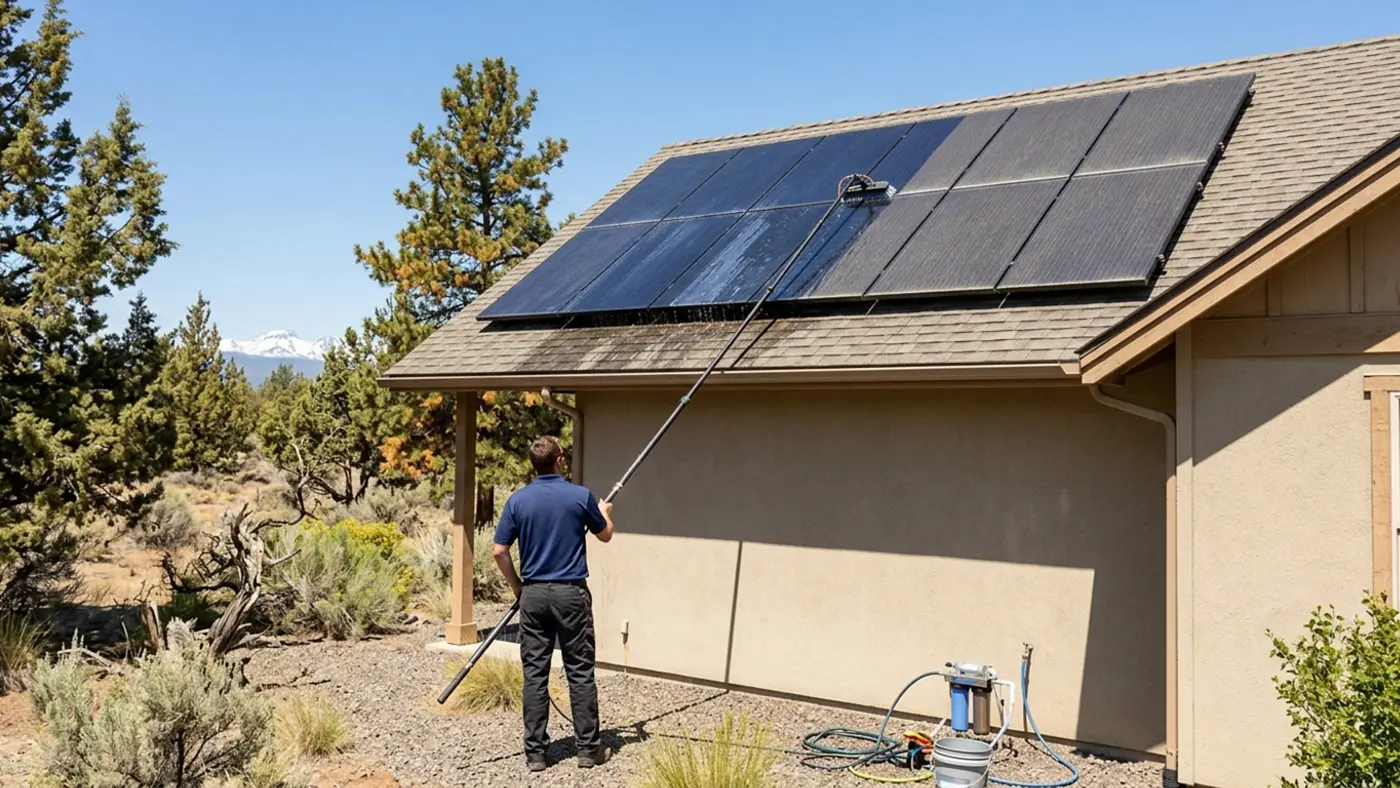
What we clean
Roof-mounted arrays · ground-mount and pole-mount systems · shop, barn, and carport arrays · panel frames and rails · the gutter run below a roof array, on request
Dust and pollen collect along the bottom rail of every panel and hold moisture there. On older systems that edge is where grime cakes hardest, and it’s the part nobody thinks to look at. It comes off with the same pass.
Ground-mount and acreage systems
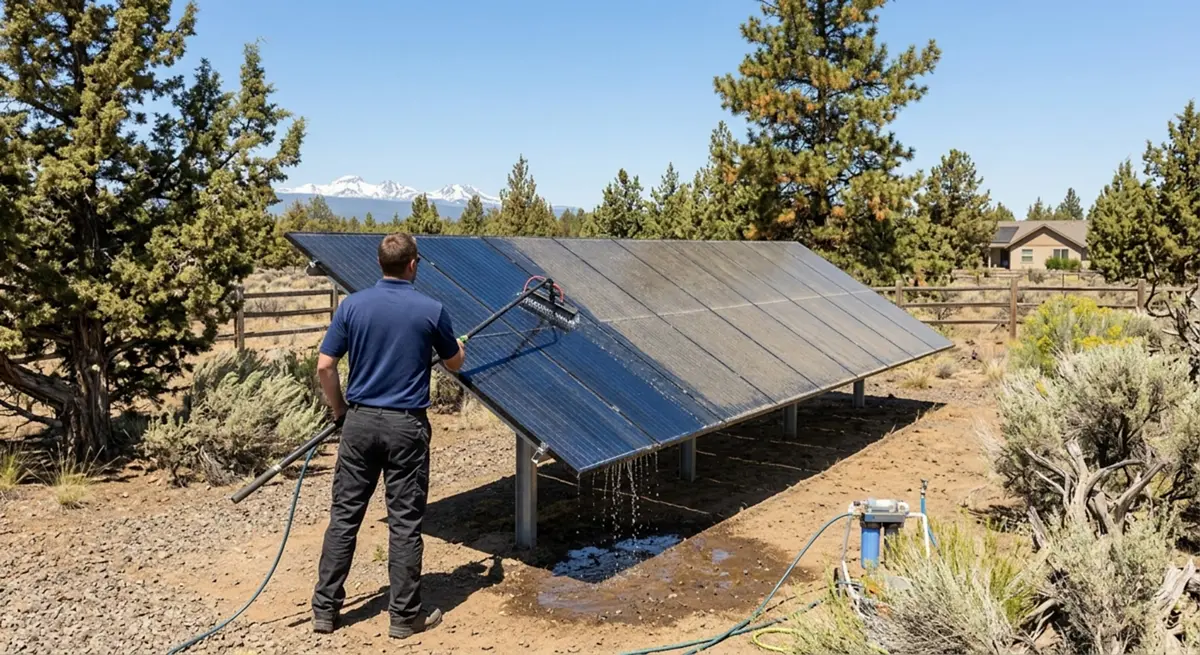
Plenty of solar around Bend sits on the ground rather than the roof, on acreage out toward Tumalo, Alfalfa, and the county roads south of town. Those systems get dirtier and they get dirty faster. A panel two feet off bare ground catches everything a gravel drive kicks up, and the low tilt angle means less of it slides off.
They’re also the easier job. No ladder, no roof pitch to work around, and we can reach the whole face of every panel. If your array is ground-mounted, this is straightforward work and usually a shorter visit than the acreage suggests.
Why Bend homes lose output
The reasons here aren’t the ones that apply west of the mountains.
The dry season doesn’t rinse. From June into October we get very little rain, which means nothing washes the panels between visits. In a wetter climate a summer storm does half this job for free. Here the dust just accumulates and stays put until someone removes it.
Pollen in spring. Ponderosa and juniper put out a heavy yellow load that sticks to glass and then bakes on once the heat arrives.
Smoke and ash in late summer. Wildfire season leaves a film too fine to spot from the ground. It settles flat across the whole panel instead of streaking, so nothing about the array looks wrong.
By September most systems are carrying the full year’s buildup. That’s also right before the sun drops low for winter and every remaining bit of production starts to matter more.
How we do it
Purified water is the entire method. We run deionized water with the minerals stripped out, so when it dries it leaves nothing behind. Tap water does the opposite: Central Oregon water is hard enough that it dries into visible mineral spots, and those spots shade cells and undo the cleaning you just paid for.
No soap, no detergent, no abrasives, and no pressure washing on the glass. Panels carry an anti-reflective coating, and harsh chemistry and scrubbing are how that coating gets stripped. A soft brush lifts the dust, purified water carries it off, and the panel dries clear on its own with no squeegee and no toweling.
We work from the ground with water-fed poles wherever the roof pitch and layout allow, which covers most single-story and many two-story homes in Bend. Nobody walks across your array. Where a panel genuinely can’t be reached from below, we get to it with proper fall protection.
Scheduling and cost
Once a year covers most rooftop homes, and the useful time to book it is late in the dry season, around September or October, after the dust and smoke have finished and before the low winter sun arrives.
Ground-mount arrays, homes on gravel drives, and properties near open fields or heavy road dust usually want it twice. If your system has monitoring, you’ll see the case for it in your own production numbers.
FAQ
How much output am I actually losing to dirt?
Enough to notice on a bill. A film of dust and pollen shades the cells directly, and at the end of a dry Central Oregon summer the buildup is at its worst. The exact figure depends on your tilt, your site, and how long it’s been. If you have production monitoring, compare this August against a clean one and you’ll have your own number.
Can’t I just spray them off with the hose?
You can, and it will look better for about a day. The problem is what our water leaves behind. Hard water dries into mineral spotting across the glass, which shades cells the same way dust does, and a hose from the ground doesn’t lift anything that’s actually bonded on. It moves dust around rather than removing it.
Do you get on my roof?
Usually not. Water-fed poles reach most home arrays from the ground, which is safer for us and means nothing is walking on your panels or your shingles. Some layouts need closer access, and we do that with real fall protection rather than improvising.
Will this void my panel warranty?
No. Manufacturers ask for exactly this: no abrasives, no harsh chemicals, no high pressure on the glass. Purified water and a soft brush is the method they specify. What voids warranties is pressure washing, scrubbing pads, and household cleaners.
Do you clean ground-mount arrays?
Yes, and they’re some of our easier work. Full access to every panel, no ladders, and no roof to work around.
Can you do this on the same visit as windows or gutters?
Yes, and most homeowners do. We’re already on the property with the purified water setup that cleans your glass, so adding the array avoids a second trip charge. See window and gutter cleaning.
How long does it take?
Most home arrays are well under a half day. Larger ground-mount systems and homes with panels on multiple roof faces take longer.
Related
Window & gutter cleaning · Pressure washing · Commercial & solar farm cleaning · Our work
Book a walkthrough
Half an hour at your property gets you a written scope and a flat price. No cost, no obligation.
Get an EstimateCall 541-604-7272
Serving Bend, Redmond, Sunriver, Prineville, Sisters, La Pine, Terrebonne and Tumalo.